
DITY Move Calculator
Planning a Permanent Change of Station (PCS) and wondering how much you could receive for a Personally Procured Move (PPM)? Our DITY Move Calculator helps you estimate your potential military moving reimbursement in just a few steps. Enter your move details, estimated household goods weight, and travel information to get a quick reimbursement estimate for a Full or Partial PPM. Whether you’re serving in the Army, Navy, Air Force, Marine Corps, Coast Guard, or Space Force, this free calculator helps you plan your PCS budget with greater confidence before your move begins.
Move Details
Your Estimate
Planning Estimate
This calculator is a planning tool only. It provides an estimated reimbursement based on the information you enter and should not replace your official PCS or PPM reimbursement provided by your transportation office.
What Is a DITY Move Calculator?
A DITY Move Calculator is a planning tool that helps military members estimate the potential reimbursement they may receive when completing a Personally Procured Move (PPM) during a Permanent Change of Station (PCS). Instead of relying on rough estimates or manual calculations, the calculator uses details such as your household goods (HHG) weight, travel distance, and estimated moving expenses to provide an approximate reimbursement before your move begins. Although “DITY” originally stood for Do-It-Yourself Move, the U.S. military now uses the term Personally Procured Move (PPM). Many service members still search for “DITY move,” so both terms are commonly used to describe the same relocation option. With a PPM, you arrange all or part of your move yourself rather than having the government coordinate it, and you may qualify for reimbursement based on the approved costs of your relocation.
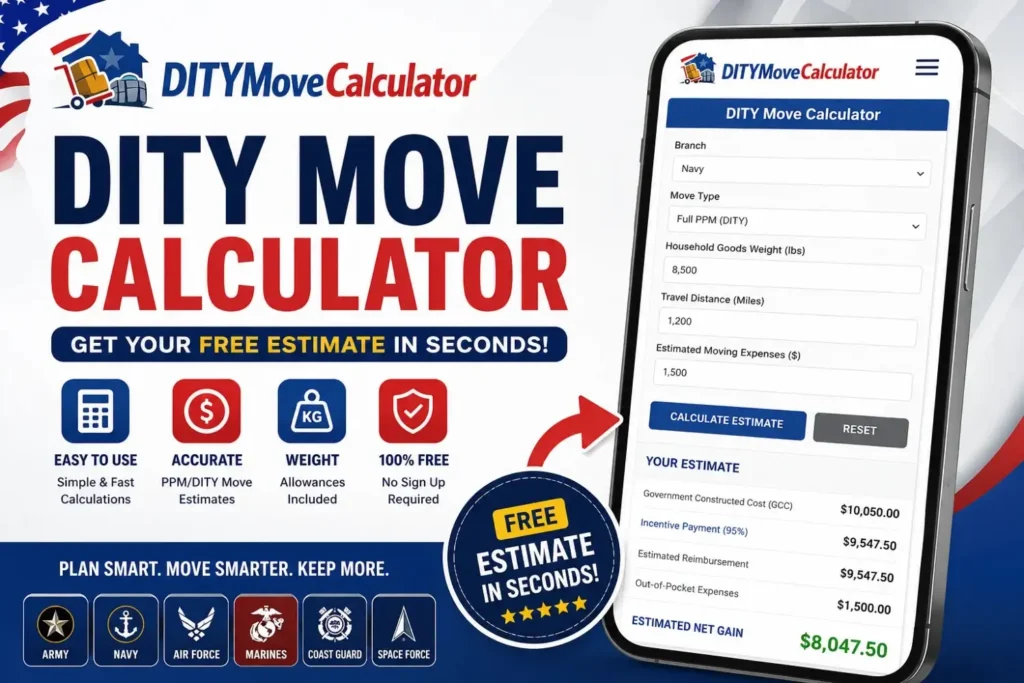
A DITY Move Calculator gives you a practical way to compare expected moving expenses with your estimated reimbursement. Whether you’re renting a moving truck, using a personal vehicle, purchasing packing supplies, or hiring moving help, seeing these estimates in advance can help you create a realistic PCS budget and avoid unexpected costs. Our calculator is designed for members of the Army, Navy, Air Force, Marine Corps, Coast Guard, and Space Force. It can be used for both Full PPM and Partial PPM moves, making it a helpful resource for active-duty service members and military families planning a relocation. While this calculator provides an estimate rather than an official payment determination, it helps you understand how key factors—such as Household Goods (HHG) weight, travel distance, eligible moving expenses, and your selected move type—can influence your expected reimbursement. For official payment amounts, always work with your installation’s transportation office and follow current Joint Travel Regulations (JTR) guidance.
How Our DITY Move Calculator Works
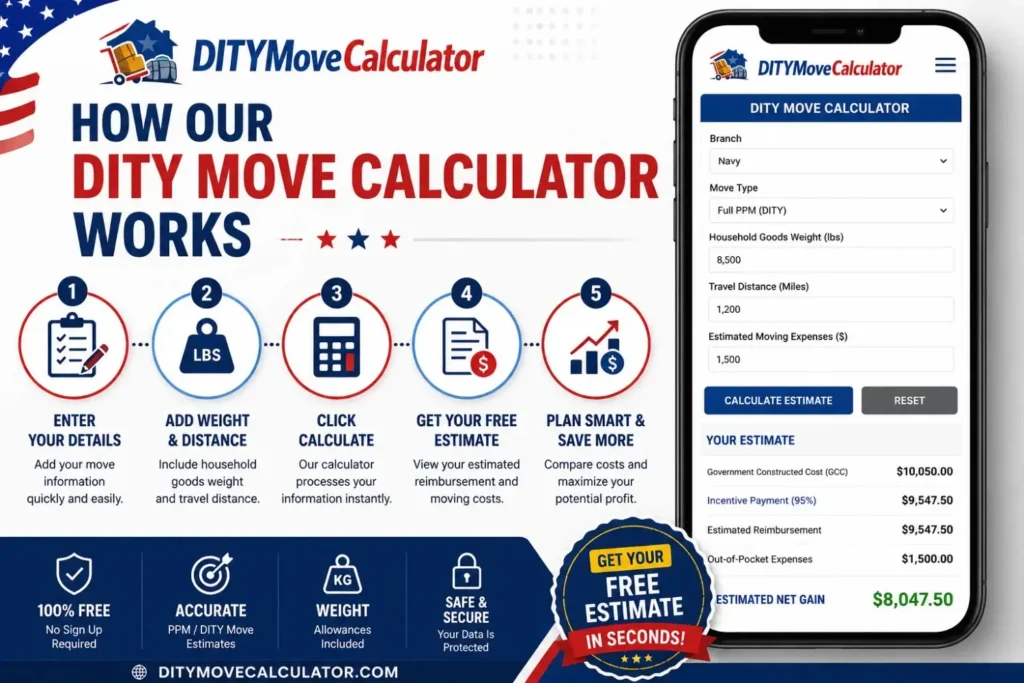
Planning a Personally Procured Move (PPM) doesn’t have to be complicated. Our calculator is designed to give you a quick reimbursement estimate using the information you already know about your move. In just a few simple steps, you can better understand your expected moving costs, compare them with your estimated reimbursement, and prepare for your upcoming Permanent Change of Station (PCS).
Enter Your Move Details
Start by selecting your military branch, choosing whether you’re completing a Full or Partial Personally Procured Move (PPM), and entering your travel information. These basic details help create a personalized estimate based on your planned relocation.
Add Your Estimated Household Goods Weight
Enter the estimated weight of your Household Goods (HHG). If you don’t know the exact weight, you can use a reasonable estimate based on the size of your home. Shipment weight is one of the biggest factors that can affect your estimated reimbursement.
Review Your Estimated Reimbursement
After entering your information, the calculator estimates your Government Constructed Cost (GCC), potential reimbursement, and estimated out-of-pocket expenses. These figures help you understand what your move may cost and how much reimbursement you could receive.
Plan Your PCS Budget
Use your estimated results to build a realistic moving budget before your PCS begins. Comparing expected reimbursement with truck rental, fuel, packing supplies, storage, and other moving expenses can help you make informed decisions and reduce unexpected costs during your relocation.
What Information Affects Your DITY Move Reimbursement?
Your reimbursement is not based on just one number. Several factors work together to estimate how much you may receive for a Personally Procured Move (PPM). Understanding these factors before you move can help you plan your budget, avoid surprises, and make informed decisions throughout your Permanent Change of Station (PCS). Our calculator uses the information you provide to create an estimate. While the final payment is determined by your transportation office and current military regulations, the details below have the biggest impact on your estimated reimbursement.
Military Branch
Your military branch may influence certain relocation policies, guidance, and available benefits. Whether you serve in the Army, Navy, Air Force, Marine Corps, Coast Guard, or Space Force, it’s important to select the correct branch when using the calculator. This helps produce an estimate that better reflects your planned move.
PCS Distance
The distance between your current duty station and your new assignment is one of the most important parts of your estimate. Longer moves usually involve higher transportation costs than shorter moves. Entering an accurate travel distance helps create a more realistic reimbursement estimate and improves your overall PCS budget planning.
Household Goods Weight
The estimated weight of your Household Goods (HHG) plays a major role in your reimbursement. Furniture, clothing, appliances, electronics, and other personal belongings all count toward your shipment weight. The closer your estimate is to your actual weight, the more useful your reimbursement estimate will be. If you are unsure of your shipment weight, use a household goods weight estimator or review previous moving records before completing the calculator.
Government Constructed Cost (GCC)
The Government Constructed Cost (GCC) is an estimate of what it would cost the government to move your household goods using an official transportation provider. This value is used as part of the reimbursement process and helps determine your estimated incentive payment during a Personally Procured Move.Our calculator provides an estimated GCC for planning purposes only. Your official amount is determined by the military transportation office.
Moving Expenses
Many service members pay for some moving costs themselves. These may include:
- Rental truck
- Fuel
- Packing supplies
- Moving labor
- Storage
- Toll roads and parking
Travel Allowances
Depending on your PCS orders and travel situation, you may qualify for travel-related allowances. These can include mileage, lodging, and other authorized travel expenses. Including your travel details helps you build a more complete moving budget and better understand the total cost of your relocation.
Partial vs Full PPM Move
Both options allow you to move your household goods, but they work differently. Choosing the right option depends on how much of the move you plan to manage yourself.
| Feature | Full PPM Move | Partial PPM Move |
|---|---|---|
| Who moves your household goods? | You arrange the entire move. | You move only part of your household goods while the government handles the rest. |
| Planning required | Higher | Moderate |
| Personal responsibility | You manage packing, transportation, and moving costs. | You manage only the portion you choose to move yourself. |
| Potential reimbursement | Based on the eligible amount for the full move. | Based on the portion of the move you complete yourself. |
| Best for | Service members who want more control over their move and expenses. | Service members who want flexibility while still using government moving services. |
What’s Included in Your Estimate?
When you enter your move details, our calculator shows more than one number. Each result is designed to help you understand your upcoming Permanent Change of Station (PCS) from a different angle. Instead of guessing what your move might cost, you can see where your money may come from, what you could spend, and how those numbers work together. While these figures are estimates, they can make planning your move much easier.
Estimated Incentive Payment
This is the estimated amount you may receive for completing a Personally Procured Move (PPM). The value is based on the information you enter, including your household goods weight and move details.
Many service members use this estimate to decide whether managing their own move could be worth the extra planning. It gives you a starting point before speaking with your transportation office.
Government Constructed Cost (GCC)
The Government Constructed Cost (GCC) is an estimate of what the government would expect to pay to move your household goods using an approved moving company.
You do not receive this amount directly. Instead, it helps determine your estimated reimbursement. Knowing this value makes it easier to understand how your estimate is calculated.
Travel Reimbursement
Your move may include travel-related costs such as mileage and other authorized travel expenses. The calculator uses your travel information to provide an estimated reimbursement for planning purposes.
This helps you prepare a more complete moving budget instead of focusing only on shipping your household goods.
Moving Expenses
Every move has costs. Truck rental, fuel, packing supplies, storage, tolls, and moving help can quickly increase your total expenses.
Adding these costs gives you a clearer picture of how much you may spend during your PCS move and helps you compare those costs with your estimated reimbursement.
Estimated Profit or Loss
This result compares your estimated reimbursement with the moving expenses you entered. If your reimbursement is higher than your costs, you could finish your move with money left over. If your expenses are higher, you may need to cover the difference yourself.
This simple comparison can help you decide whether to adjust your moving plans before your PCS begins.
Why These Estimates Matter
One of the biggest mistakes people make during a military move is looking only at the estimated reimbursement. A smart PCS plan considers every part of the move, including household goods weight, travel costs, rental equipment, fuel, and other moving expenses. Looking at all of these estimates together gives you a more realistic picture of your total moving budget and helps you make better decisions before moving day.
Full PPM vs Partial PPM
When planning a Permanent Change of Station (PCS), one of the biggest decisions is whether to complete a Full Personally Procured Move (PPM) or a Partial PPM. Both options can help you move your household goods, but they work in different ways. Understanding the differences can help you choose the option that fits your budget, schedule, and moving experience.
| Feature | Full PPM | Partial PPM |
|---|---|---|
| How the Move Works | You arrange and complete the entire move yourself. | You move only part of your household goods while the government moves the rest. |
| Household Goods | You are responsible for transporting all authorized household goods. | You move selected items, while the remaining shipment is handled through a government-arranged move. |
| Planning Required | Higher. You organize the truck, packing, transportation, and schedule. | Moderate. You only manage the portion you choose to move yourself. |
| Moving Costs | You usually pay most moving expenses before requesting reimbursement. | Your personal expenses are generally lower because only part of the move is self-managed. |
| Potential Reimbursement | Based on the eligible amount for the entire personally procured move. | Based only on the portion of household goods you personally transport. |
| Flexibility | Maximum control over your moving schedule. | Good flexibility while still using government moving services. |
| Best Choice For | Service members who want full control and are comfortable managing the entire move. | Families who want extra flexibility without taking responsibility for the complete relocation. |
When a Full PPM Makes Sense
A Full PPM is often a good option if you want complete control over your relocation. You choose how your household goods are packed, transported, and delivered. Many military families also appreciate being able to set their own moving schedule instead of waiting for available moving dates.
- You prefer to manage every part of the move.
- You already have access to a truck or trailer.
- You are comfortable keeping receipts and weight tickets.
- You want more flexibility during your PCS.
When a Partial PPM May Be Better
A Partial PPM works well if you only want to move a few important items yourself while letting the government handle the larger shipment. Many families use this option for valuables, personal vehicles, or items they want immediately after arriving at their new duty station.
- You want less responsibility during the move.
- You only plan to transport part of your belongings.
- You prefer a balance between convenience and flexibility.
- You still want the opportunity to receive reimbursement for the items you move yourself.
Planning Tip Before You Decide
Before choosing between a Full PPM and a Partial PPM, estimate your household goods weight, expected travel distance, truck rental, fuel, packing supplies, and other moving expenses. Comparing these costs with your estimated reimbursement gives you a clearer picture of which option makes the most sense for your situation. Every PCS is different, so taking a few minutes to plan ahead can save both time and money during your move.
Final Thoughts
Planning a military move comes with a lot of decisions, but having a clear estimate before you begin can make the process much easier. Whether you’re preparing for your first Permanent Change of Station (PCS) or you’ve completed several moves during your career, understanding your expected reimbursement and moving costs helps you plan with greater confidence. Our DITY Move Calculator is designed to give you a practical starting point. By entering your household goods weight, travel distance, move type, and estimated expenses, you can quickly see how different factors may affect your overall moving budget. While the results are estimates and not official payment amounts, they can help you compare options, prepare your paperwork, and avoid unexpected costs along the way.
Before your move, take time to gather your PCS orders, certified weight tickets, receipts, and other required documents. Keeping accurate records throughout the move can make the reimbursement process much smoother. Use the calculator whenever your moving plans change. Updating your estimated weight or expenses only takes a few moments and can give you a clearer picture of your expected costs before moving day. We regularly update our calculator and educational resources to reflect current military relocation guidance, helping service members and military families make informed decisions throughout every stage of their PCS journey.
Frequently Asked Questions
Planning a military move often raises questions about reimbursement, paperwork, and eligibility. Below are answers to some of the questions service members ask most often before completing a Personally Procured Move (PPM).
A DITY Move, short for Do-It-Yourself Move, is the traditional name for what is now called a Personally Procured Move (PPM). Instead of having the government arrange your relocation, you manage all or part of the move yourself. Many military members choose this option because it offers greater flexibility and may reduce moving costs if planned carefully.
A Personally Procured Move (PPM) allows eligible service members to transport their own household goods during a Permanent Change of Station (PCS). You can complete the entire move yourself or move only part of your belongings while the government handles the rest.
This calculator provides an estimate based on the information you enter, such as household goods weight, travel distance, and moving expenses. It is designed to help you plan your budget before moving. Your final reimbursement is determined by your transportation office using current military regulations and your official documentation.
Several factors can affect your estimated reimbursement, including your household goods weight, travel distance, move type, and eligible moving expenses. The military also considers the estimated cost of moving your shipment through government transportation when determining reimbursement.
Some service members spend less on their move than their approved reimbursement and keep the remaining amount after eligible expenses. Others may spend more than expected. Every move is different, so creating a realistic budget before your PCS is one of the best ways to avoid surprises.
The Government Constructed Cost (GCC) is an estimate of what it would cost the government to move your household goods using an approved transportation provider. This amount helps determine your estimated reimbursement but is not the amount paid directly to you.
Eligible expenses vary by your orders and current travel regulations. Common examples include truck rental, packing supplies, fuel, storage, and other approved moving costs. Keeping organized receipts and supporting documents makes the reimbursement process much easier.
In most Personally Procured Moves, certified weight tickets are required because they verify the weight of your household goods. Missing or incorrect weight tickets can delay your reimbursement, so it is important to keep them with your moving records.
A Full PPM means you arrange and complete the entire move yourself. A Partial PPM means you move only part of your household goods while the government transports the remaining items. The right option depends on your moving plans, available time, and budget.
Yes. The calculator is designed for military members across all major U.S. service branches. It provides planning estimates for PCS moves, whether you serve in the Army, Navy, Air Force, Marine Corps, Coast Guard, or Space Force. Final reimbursement is always determined by your transportation office and current military travel regulations.